





Table of Contents Show
A good watch deserves a strap built to the same standard. That sounds obvious, but the sailcloth category has grown quickly, and the word “premium” now appears on straps that share little beyond a textured surface. Some are engineered from the lining outward; others are a printed pattern on a budget synthetic with a stitched border.
The difference is not always visible in a product photo. It shows up in the layers you can’t see, in how the strap behaves after a month on the wrist and in whether it can actually do what the listing claims. This guide works through a sailcloth strap layer by layer so you know what to look for before you buy.
Why Collectors Have Turned to Sailcloth
Leather is the traditional choice and rubber is the practical one. Sailcloth sits between them: technical in texture, but tailored enough to wear with a shirt cuff. It gives a dive watch or a chronograph a purposeful look without the heft of a thick rubber strap, and it avoids the maintenance that leather demands around water.
That is why it has found a home on divers, GMTs and modern sport-luxury watches. Watches such as the Omega Seamaster and Speedmaster have become common test cases in enthusiast reviews, and the pairing tends to work because the strap’s marine character matches the watch’s own.
The Upper: Texture and Consistency
Start with the surface, because that is where the term “sailcloth” comes from. The name refers to the look of woven sail fabric, and in practice the upper may be a technical weave, an embossed synthetic or a rubberised hybrid. None of these is inherently better; the material simply needs to be honest about what it is and executed well.
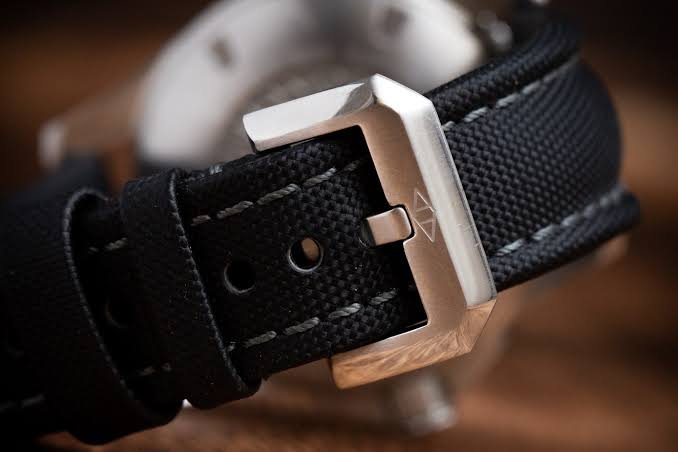
On a premium strap the texture is dense, even and consistent from lug end to tail. There should be no thin patches, no areas where the pattern fades and no visible glue line where the upper meets the edge. Run a finger along it: the surface should feel firm and uniform rather than soft and spongy.
Stitching and Edges
Stitching is the quickest quality tell. Look for straight lines, tight tension and even spacing, with no loose ends or doubled-over sections at the corners. Thread should sit slightly recessed rather than proud, where it would catch and fray.
Edges deserve equal attention. Whether they are painted, sealed or heat-finished, they should look deliberate and hold up at the spring-bar openings, the buckle holes and around the keepers. These are the points that take the most strain, and a cheaply made strap usually starts to fail there first.
The Lining: Where Water Resistance Is Decided
Turn the strap over. The lining decides how the strap wears and how it copes with moisture, and it is the single biggest reason two straps that look identical from the front can perform completely differently.
Leather-lined sailcloth straps are comfortable and traditional but should be treated as everyday, water-tolerant straps rather than swimming straps. Synthetic or rubber-based linings, such as FKM, handle repeated wet use far better and are the right choice for anyone who actually swims in their watch.
Specialist makers usually state this plainly. Artem Straps, for example, separates its water-resistant collections, such as the Loop-less Standard and Classic Standard ranges, from its other constructions, which makes it easier to match a strap to how the watch will really be worn. Whatever the brand, a listing that says “water resistant” without explaining the lining is not telling you enough.
Padding and Proportion
Padding is a matter of balance rather than volume. A 44mm diver on a thick, heavily padded strap looks intentional; the same strap on a slim 38mm watch looks clumsy. The strap should support the visual weight of the case without adding bulk of its own.
Premium straps also hold their shape. They curve to the wrist without collapsing, and they don’t go limp after a few weeks. A strap that feels structured out of the box and stays that way is a sign of proper internal construction.
Hardware and Attachment
The buckle is part of the strap, not an accessory to it. A premium sailcloth strap comes with a solid, cleanly finished buckle or deployant clasp that matches the case finish, sized to a sensible taper.
Deployant clasps deserve a mention here. Because the strap is never bent sharply around a pin, a deployant reduces wear at the buckle point and gives a cleaner profile under a cuff. On a strap intended for daily use, that is a practical advantage rather than a cosmetic one.
Check the spring bars too. They should be sturdy, correctly sized for the lug width and, on straps with quick-release tabs, firmly seated with no play.
Sailcloth on a Dive Watch
For most owners a dive watch spends its life at desks, dinners and the occasional pool, and for that a sailcloth strap is close to ideal. It suits the design language of the watch and wears more comfortably than heavy rubber in hot weather.
If the watch will see regular saltwater, frequent swimming or actual diving, be selective. Choose a synthetic or rubber-lined construction, confirm the maker’s water-resistance claim, and make sure the clasp and spring bars are secure enough for active use. A textured surface alone tells you nothing about what the strap can withstand.
A Quick Checklist
Before you order, work through the strap from the outside in:
- Upper: dense, even texture with no thin or glossy patches
- Stitching: straight, tight, evenly spaced, recessed
- Edges: cleanly finished, especially at spring-bar holes and buckle holes
- Lining: stated clearly, and suited to how you’ll wear the watch
- Padding: proportionate to the case, holds its shape
- Hardware: solid buckle or deployant, matched finish, secure spring bars
- Fit: correct lug width, taper and length for your reference
- Claims: water resistance and materials explained, not just asserted
Is a Premium Sailcloth Strap Worth the Money?
On the right watch, yes. A well-made strap changes how a watch sits, how it balances and how often it leaves the box. Plenty of collectors will tell you that a watch they rarely wore on its bracelet became a daily piece after a strap change.
The word “premium” costs nothing to print. What you are paying for is the sum of the decisions underneath it: the lining chosen for the intended use, the stitching that stays put, the edges that don’t lift and the hardware that feels like it belongs on the watch. Judge a sailcloth strap by those, and the label takes care of itself.