


Table of Contents Show
Albania has become one of Europe’s fastest-growing destinations for road trips, largely because the country is small enough to cross in a day but varied enough that the drive itself is the point. What catches most first-time drivers off guard isn’t the scenery, though — it’s the gap between the motorway network, which is modern and straightforward, and the mountain roads, which are not.
If you’re planning to drive there, here’s what actually matters: the paperwork, the road rules that differ from what you’re used to, and — the decision most people get wrong — which vehicle to book.
Documents You’ll Need
Requirements are simpler than most people expect, but the details vary by nationality and by rental company, so it’s worth confirming before you fly rather than at the counter.
- Driving licence: EU, UK, and US licences are generally accepted for short visits. Licences in non-Latin scripts are the usual sticking point.
- International Driving Permit: Not universally required, but cheap, quick to obtain, and it removes an argument at the desk. Get one if your licence isn’t in Latin characters.
- Passport and a credit card: Most companies hold the security deposit on a credit card in the main driver’s name. Debit cards are frequently refused — this is the single most common reason people get turned away at pickup.
- Minimum age and licence tenure: Typically 21, with the licence held for at least one year. Younger drivers usually pay a surcharge.
- Green Card insurance: Essential if you plan to cross into Montenegro, Kosovo, North Macedonia, or Greece. Cross-border travel almost always needs to be declared and authorised in advance — don’t assume it’s included.
The Road Rules That Actually Differ
Albania drives on the right, and the core rules will feel familiar to anyone who has driven in continental Europe. A few specifics are worth knowing in advance, and Rent Point Albania’s rundown of the local traffic rules covers the current requirements in more detail if you want the full picture before you go.
- Alcohol limits are effectively zero. Enforcement is real and the tolerance is minimal. Treat it as no drinking at all if you’re driving.
- Headlights and seatbelts. Dipped headlights are expected outside built-up areas; seatbelts are mandatory front and rear.
- Speed limits step down sharply. Motorway limits drop quickly on approach to towns, and the transition is often signed only once. Fixed cameras and police checkpoints are both common.
- Defensive driving is the norm. Overtaking on two-lane roads is more assertive than in Western Europe, and you should expect livestock, pedestrians, and slow agricultural vehicles on rural stretches. Night driving on unlit mountain roads is best avoided entirely.
Choosing the Right Car: The Decision Most People Get Wrong
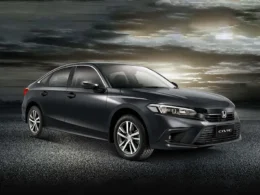
There’s a persistent assumption that Albania requires a 4×4. For the majority of itineraries, it doesn’t — and the oversized vehicle actively causes problems.
Where a Compact Car Wins
The main north-south corridor — Tirana down through Fier and Tepelena toward Gjirokastra, roughly 230 km — is highway and well-maintained national road throughout. A small hatchback handles it comfortably, uses far less fuel, and, critically, fits the historic town centres at the other end. The old quarters of Gjirokastra and Berat have cobbled lanes that were laid out for pedestrians and pack animals; a large SUV becomes something you have to park at the bottom of the hill and walk away from.
Where You Genuinely Want Higher Clearance
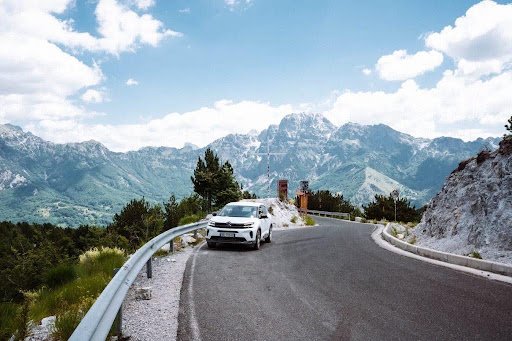
The exception is the mountain north. The route toward Theth in the Albanian Alps, and some approaches into remote valleys, involve unsealed sections, steep gradients, and switchbacks where ground clearance matters. If that’s on your itinerary, book an SUV specifically for it. Note that many rental agreements explicitly exclude unpaved roads — check the contract terms rather than assuming, because damage sustained off-tarmac is a common exclusion.
Manual vs Automatic
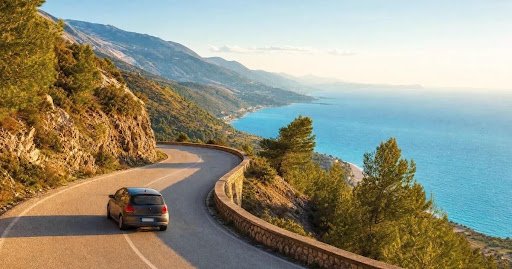
Manual transmissions dominate the local fleet and are cheaper. Automatics are worth the premium on two conditions: if you’re not confident hill-starting on a gradient, or if your route involves a lot of switchback driving, where constant shifting on winding descents gets tiring fast. On the coastal mountain passes in particular, an automatic meaningfully reduces fatigue.
Practical Things Worth Knowing
- Fuel stations thin out in the mountains. Fill up in larger towns before heading into rural areas rather than running the tank low.
- Carry some cash. Card acceptance is good in cities and patchy in villages and at small parking areas.
- Document the car at pickup. Photograph every panel, the wheels, the windscreen, and the fuel gauge before you leave the lot. This is standard advice anywhere, and it’s the cheapest insurance there is.
- Download offline maps. Mobile coverage is reliable on main routes and unreliable in mountain valleys. Don’t rely on live navigation in the north.
- Parking in old towns is on the perimeter. Plan to leave the car at the edge of historic centres and continue on foot — this is normal, and signposted.
The Bottom Line
Albania is a genuinely rewarding country to drive, and the barriers are lower than its reputation suggests. The paperwork is manageable, the motorways are good, and the main risks are the predictable ones: unlit mountain roads at night, assertive overtaking, and booking a vehicle that’s wrong for the route.
Match the car to the itinerary rather than to worst-case assumptions, sort the cross-border insurance before you travel if you’re leaving the country, and the rest is just driving.