



Table of Contents Show
The easiest way to make a watch feel brand new is to change the strap. It is also the most common way to scratch one. Nearly all lug scratches come from a metal tool slipping off a spring bar and skidding across the case. It’s not about skill; it’s about setup. With the right tool, light, and grip, the job gets easy, secure, and done in about two minutes.
What you need
- A spring bar tool. The fork end removes bars; the pointed end inserts them. A cheap one will do; a sharp, unbent one is better.
- A soft surface. Microfibre cloth or watch cushion. Never a bare desk, never a hard mat.
- Good light. You need to see the gap between the strap and the lug. Desk lamp or daylight will suffice.
- Tape (optional). To prevent damage to the case during the job, put a strip of low-tack tape on the inside of each lug. Many watchmakers do this regularly.
- The new strap, ready. Before you begin, make sure the width matches the lug gap. A 20 mm strap will NOT fit 22 mm lugs.
Removing the old strap
You must take out the old strap to install the new one.
- Place the watch face down on the cloth with the strap flat and the lugs towards you.
- If you’re using tape, stick a small piece to the inside of each lug, and leave the hole for the spring bar uncovered.
- Insert the forked end of the tool into the gap between the strap and the lug, from the inside, and seat it on the shoulder of the spring bar.
- Gently push the bar inwards, in line with the bar. Do not lever the tool on the bar, but keep it parallel to it.
- While compressing the bar, push the strap to the side and down. The bar will come free on that side.
- Remove the strap and then manually remove the bar from the other hole.
- Repeat for the second half of the strap.
Fitting the new strap
To attach the new strap:
- Place the spring bar in the new strap and test for free movement.
- Put one end of the bar into the strap hole and press the other end into the seat hole.
- Compress the free end of the bar with the pointed end of the tool (or your thumbnail).
- Line it up with the second hole and release. You should hear or feel a click.
- Tug the strap firmly. If the bar isn’t seated on either side, the strap will shift or come away. Double-check the seats; don’t leave them to chance.
- Make sure both ends of the bar are fully inserted into the lug holes.
If a strap is slightly loose between the lugs, it isn’t fully seated. Reseat it before wearing.
Quick-release straps: the no-tool option
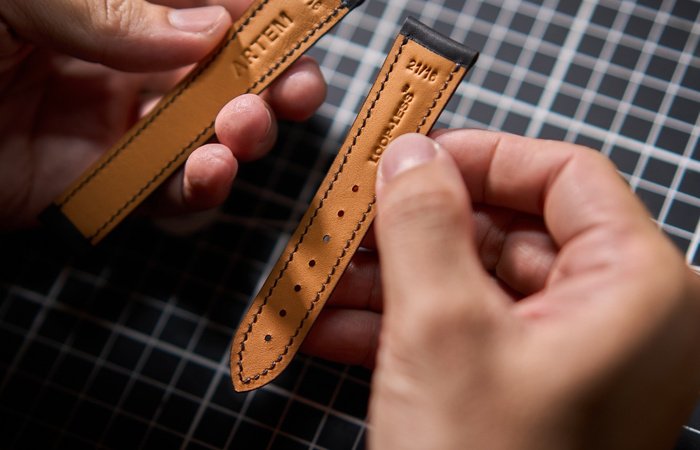
Many current straps feature quick-release spring bars. A small tab under the strap lets you slide the bar with a fingernail to compress it. No tool touches the case, so no scratches.
To remove: turn the watch over, pull the tab towards the centre of the strap, and lift the strap out. To fit: seat one end, pull the tab down, then line up the other end and release. Afterward, pull it firmly.
Mistakes that cause scratches
- Working on a hard surface. The watch can slide, and the tool can slip. Use a cloth.
- Levering rather than pressing. The fork is made to compress the bar, not pry it. Levering drives the tip into the lug.
- Working from the outside of the lug. Always work from the inside; a tool that slips on the outside lands on the case.
- Using a worn tool. A bent fork slips off the bar. Change it – they are inexpensive.
- Hurrying the second side. The majority of the slips occur when the end is already free, and the strap is loose.
- Wrong strap width. A strap a millimetre too wide puts tension on the bar and causes the lug edges to scuff. Check first.
- Using an old spring bar. Bars wear. If one feels weak or does not bounce back cleanly, change it out. If a bar fails, the watch hits the floor.
Final Words
Soft surface, good light, work from inside, press (don’t lever), and tug to test. Do those five things and you won’t scratch a lug. Skip any of them, and it only takes one slip.