



Table of Contents Show
Every few years a new strap material gets its moment. Rubber had one. Sailcloth is having one now. Through all of it, leather stays where it has always been: on the wrists of people who want their watch to look finished. There’s a reason the strap that ships with most dress watches, and a fair number of sports watches, is still leather. Nothing else does quite the same job.
If you’ve been wondering whether a leather strap is worth it, or which one to buy, here’s the case for leather and what to look for when you choose one.
Leather is the only strap that gets better with wear
Rubber looks its best on the day it arrives and slowly declines. Nylon softens and frays. Leather goes the other way. The surface darkens where your hand rests on it, the edges take on a soft sheen, and the strap picks up a pattern of light creases that belongs to your wrist and nobody else’s.
That ageing process, the patina, is why a two-year-old leather strap is often more attractive than a new one. It’s also why leather is the one strap people tend to keep rather than replace. A watch on a strap you’ve worn for years feels different from a watch on a strap you bought last week.
Not all leather does this well. Heavily coated or painted leathers resist patina and tend to crack rather than age. Full-grain leather with a natural finish is what you want if character is the point.
It does the formal job nothing else can
A sports watch on rubber is fine for a beach. A sports watch on nylon is fine for a weekend. Put either under a shirt cuff at a wedding or across a boardroom table and it reads as slightly out of place.
Leather solves that. A dark leather strap turns a diver or chronograph into something you can wear with a suit without it looking like gym kit. It’s the only strap material that moves comfortably between a Monday meeting and a Saturday dinner, and that versatility is why so many collectors keep a leather strap on hand even if the watch spends most of its time on something else.
It’s comfortable in a way synthetic materials aren’t
Rubber seals against the skin. On a hot day, that means sweat with nowhere to go. Leather breathes, flexes with the wrist, and once it’s broken in it stops feeling like a separate object and starts feeling like part of the watch.
The break-in period is the one real drawback, and it varies a lot. Cheap leather can feel like cardboard for weeks. Good leather is soft within days. The best leathers, like French Barenia®, feel broken in from the first wear because the hide is tanned and finished to be supple rather than stiff. If you’ve been put off leather by a strap that never softened, the leather was the problem, not the material.
What to look for in a leather watch strap
Price alone doesn’t tell you much. These five things do.
The leather itself. Full grain means the top surface of the hide has been left intact, which is what allows it to develop patina. Avoid anything described as “genuine leather” without further detail, which usually means lower-grade split leather with a coated surface.
The edges. A well-made strap has edges that are sealed, painted or burnished so they don’t fray. Rough or peeling edges are the first sign of a cheap strap.
The stitching. Stitches should be even, tight and sit flush with the surface. Tonal stitching looks cleaner on formal watches; contrast stitching is more casual.
The hardware. A thin, stamped buckle undoes everything the leather gets right. Look for solid stainless steel, properly finished, and ideally a choice of brushed or black to match the case.
The fastening. A traditional pin buckle is classic and easy to adjust. A deployant clasp protects the leather by removing the daily pull-through and gives a cleaner look under a cuff. Some brands now offer leather straps built specifically around a clasp, with no loose tail and no keepers, which is the best of both.
Why Artem Straps is the one to look at
Artem Straps built its reputation on sailcloth and rubber, which makes its approach to leather interesting: the brand came to it late and applied the same standards it had already set elsewhere.
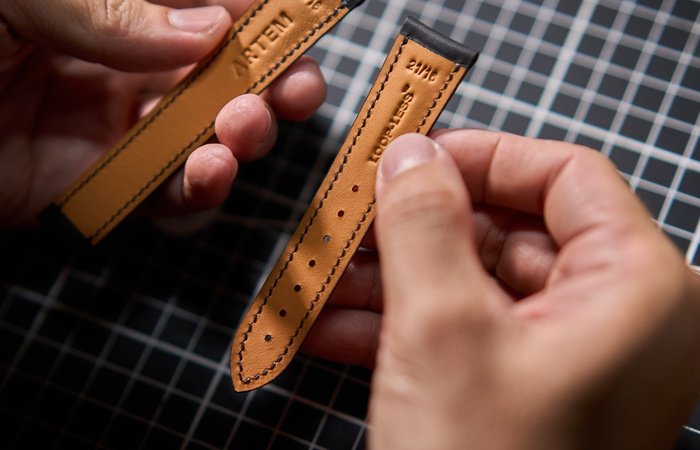
Its leather watch straps are cut from French Barenia® full-grain leather, the same hide used by the top French leather houses. That matters for two reasons. First, Barenia® is tanned to feel broken in from day one, so there’s no stiff first fortnight. Second, it’s one of the best leathers in the world for developing a rich, even patina, which is the whole point of buying leather.
The collection comes in three editions, each with tonal stitching: Saddle Tan, which shows the patina most clearly; Bridle Brown, the versatile middle ground; and Forge Black, the dressiest of the three. All three are built on Artem’s Loop-less™ design, which pairs the strap with a folding deployant clasp in stainless steel or black DLC. The clasp is sold separately, but it removes the keepers and the loose tail entirely, so the strap sits flat under a cuff and the leather isn’t pulled through a buckle every morning. That’s a meaningful difference on a material you intend to keep for years.
Each strap is $189, with a two-year craftsmanship warranty and 30-day returns. For a full-grain Barenia® strap with proper hardware, that’s priced where good leather sits, not above it.
A few words on care
Leather asks for a little more than rubber, but not much. Keep it out of the sea. Let it dry naturally if it gets damp. Wipe it with a soft cloth now and then. If the watch is going swimming or to the gym, swap to a rubber strap for the day and put the leather back on afterwards. With quick-release spring bars, that’s a thirty-second job.
Treat it that way and a good leather strap will outlast several synthetic ones, and look better at the end than it did at the start.
The short version
Go with leather if you want a strap that looks right in formal settings, feels better the longer you wear it, and becomes genuinely yours over time. Choose full-grain leather with sealed edges and solid hardware. And if you want the shortest route to a strap that gets all of that right, the Barenia® collection at Artem Straps is a very good place to start.